An electric car can show 80 per cent in its traction battery and appear lifeless the next morning. The doors may not unlock, the displays remain dark and pressing the start button produces nothing. Energy for many kilometres is present, but the car cannot connect it to the vehicle.
The usual suspect is the small low-voltage battery. Most electric vehicles retain a 12-volt system for controls and automotive equipment. Some newer designs use another low-voltage architecture, but the principle remains similar.
Two Batteries Perform Different Jobs
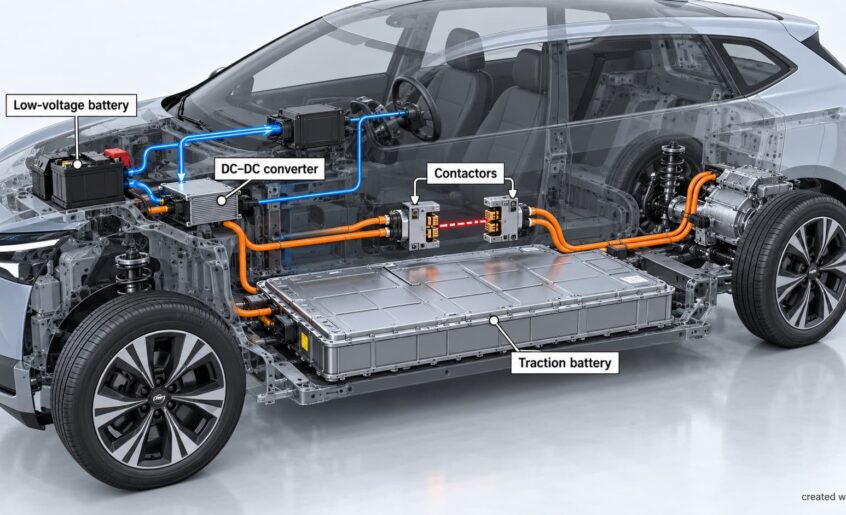
The traction battery stores energy for propulsion and operates at hundreds of volts. When the car is parked, contactors isolate that pack. Closing them requires working control modules, which depend on the low-voltage system.
The two batteries therefore serve separate purposes:
| System | Main responsibilities | What happens when it fails |
| Traction battery | Drives the motor and supplies major high-voltage loads | Range falls or the vehicle cannot propel itself |
| Low-voltage battery | Wakes computers, operates locks and closes contactors | The vehicle may appear dead despite stored driving energy |
Once the contactors close, a DC–DC converter reduces voltage from the traction pack and supplies the low-voltage network. An EV has no engine-driven alternator, yet it needs this smaller reserve to begin that process.
A Small Failure Creates Large Symptoms
A weak auxiliary battery may illuminate a lamp but collapse when several control units wake together. Voltage can fall far enough for modules to restart or report unrelated faults. Owners may see flickering displays, failed remote unlocking, warning messages or an inability to select Drive.
Age is one cause. A light left on, an accessory used while parked or a dash camera with an unsuitable cut-off setting can also drain the battery. Repeated short journeys may give a degraded unit too little time under active DC–DC charging. Cold weather can expose weakness.
Software normally monitors low-voltage charge and may wake the high-voltage system to replenish it. That protection has limits. The car may restrict support when the traction battery is low, while a damaged auxiliary battery may no longer retain sufficient charge.
Real Cars Demonstrate the Dependency
Tesla documents an extreme version of this relationship. If a Model Y exhausts its driving range, its low-voltage system eventually loses support. The vehicle cannot begin charging the traction battery until external power wakes the necessary electronics. Tesla’s official recovery instructions require low-voltage support before the charging cable can restore the high-voltage pack.
The example concerns an empty traction battery, but it reveals the sequence: charging hardware and battery controls need low-voltage power before the large pack can participate. With a full traction pack and failed auxiliary battery, the blocked step occurs earlier.
Designs also vary. Some vehicles use replaceable lead-acid units, others use lithium low-voltage batteries, and certain hybrids integrate the auxiliary supply into a larger assembly. A recovery method suitable for one model cannot be assumed for another.
Clues Pointing to the Low-Voltage Side
Several symptoms make an auxiliary-battery problem more plausible:
- the traction battery had ample charge when the vehicle was parked;
- remote locks, cabin lights and displays are inactive;
- the charging port will not open or charging will not initiate;
- warning messages appeared shortly before shutdown;
- low-voltage support restores operation temporarily.
These signs are not a diagnosis. A damaged key, blown fuse, software fault or high-voltage safety shutdown can produce overlapping behaviour. Repeated failures after a successful boost require a battery and charging-system test.
Recovery Depends on the Model
Manufacturers provide dedicated jump points because direct battery access may be difficult. Only the specified low-voltage terminals should be used; orange high-voltage cables and traction-battery components are not part of a roadside jump procedure.
The general response is cautious:
- Consult the correct manual for the model and production year.
- Locate the designated positive point and approved chassis ground.
- Connect a suitable 12-volt support source in the stated sequence.
- Place the vehicle in its ready state.
- Disconnect the source as instructed and arrange testing.
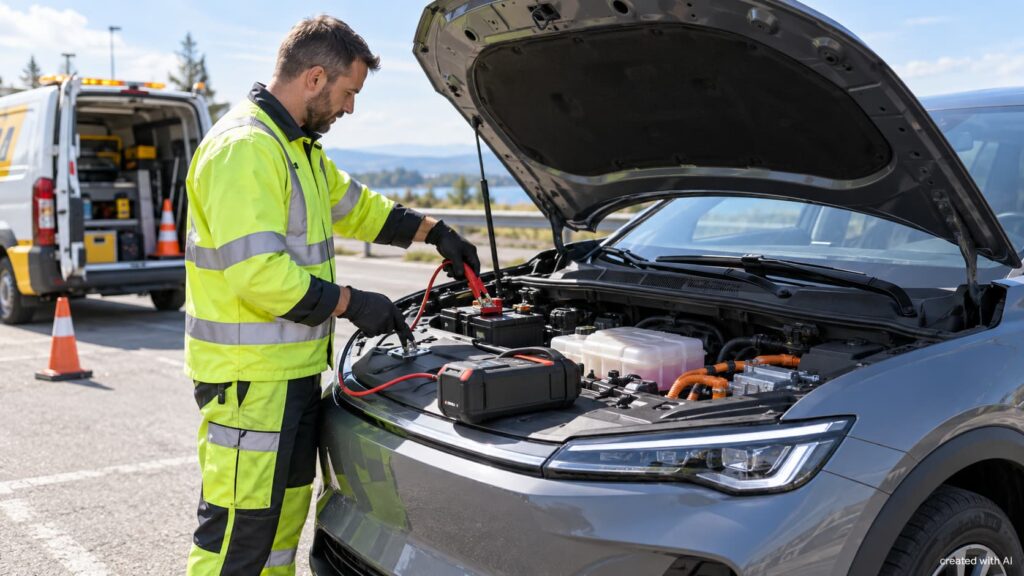
Some Kia hybrids illustrate why precise instructions matter. Their official manual describes an integrated lithium low-voltage battery and a reset button that must be followed by starting the vehicle promptly. That feature does not establish a universal procedure for Kia EVs or other models.
A portable jump pack may wake a compatible vehicle, but it does not repair a worn battery. A recurring failure calls for checks of the battery, DC–DC converter, software and abnormal parked loads.
Full Charge Is Only One Condition
The dashboard percentage describes energy stored for driving; it does not certify every electrical system. An EV must unlock, boot its controllers, complete safety checks and close its contactors before the large battery can deliver useful power.
That sequence explains the apparent contradiction. A fully charged EV can remain stationary because the smallest battery controls access to the largest one.